
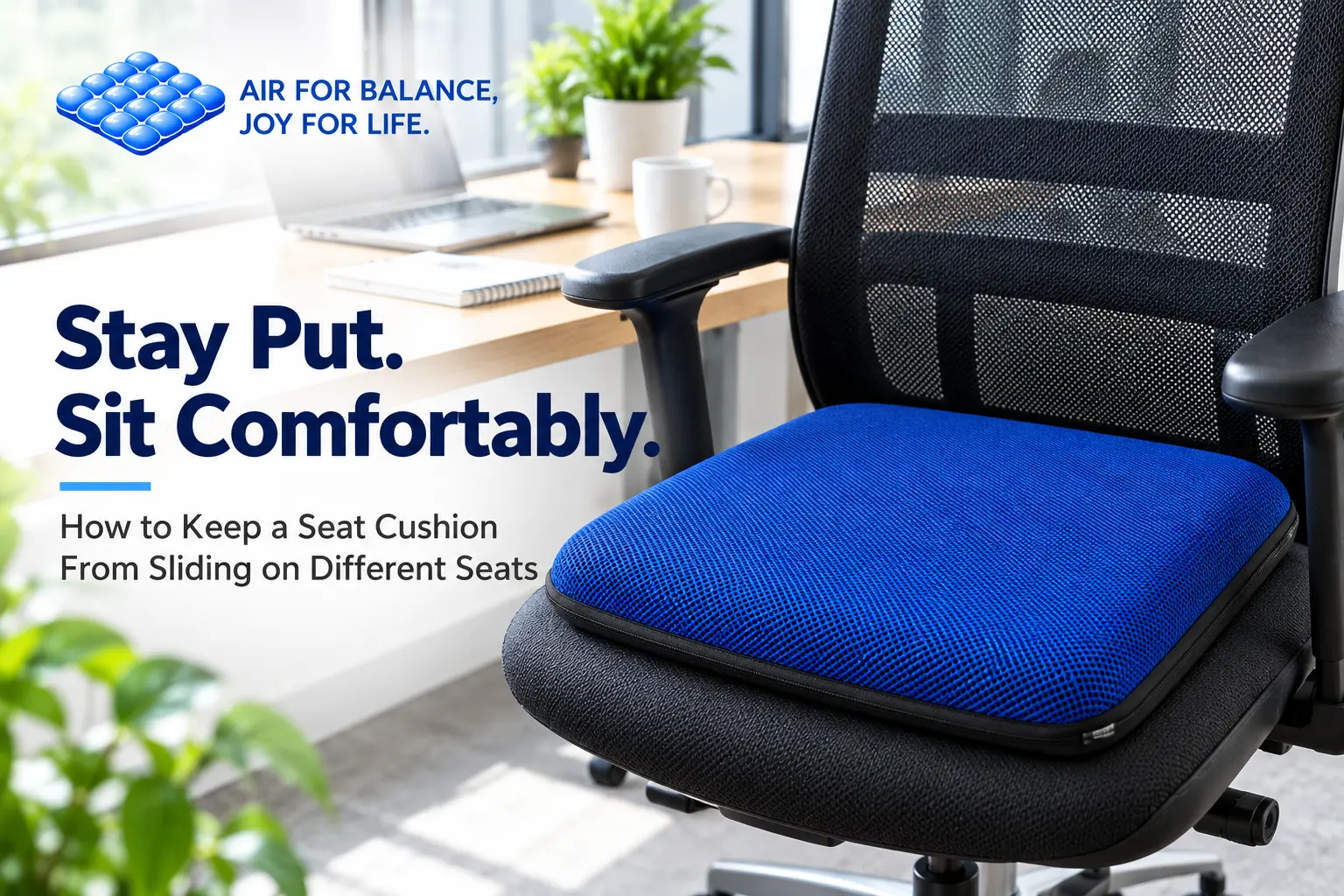
A seat cushion can make a hard, flat, or unsupportive chair more adaptable for everyday sitting. But there is one problem that can quickly become frustrating: the cushion keeps moving.
Maybe it slowly slides forward while you work. Perhaps it shifts when you get into your car. Or you find yourself repositioning it every time you stand up and sit down.
If you are wondering how to keep a seat cushion from sliding, the answer is not simply to find a heavier cushion.
Stability depends on several factors working together: the chair surface, cushion size, bottom material, sitting position, and—in the case of an adjustable air cushion—the amount of inflation.
Understanding these factors can help you create a more stable sitting setup without sacrificing adjustability or comfort.
Why Does a Seat Cushion Keep Sliding?
A cushion moves when the horizontal forces created by your body are greater than the friction between the cushion and the chair.
When you lean forward to reach your keyboard, shift your weight, get into a vehicle, or push yourself up from a chair, your body does not apply pressure only downward. It also creates forward, backward, and sideways forces. If the bottom of the cushion cannot resist those forces, the cushion moves.
1. The Chair Surface Is Smooth
Leather and synthetic leather seats can provide less friction than textured fabric surfaces. A cushion that remains stable on a fabric office chair may behave differently when placed on a smooth vehicle seat or leather chair.
2. The Cushion Does Not Fit the Seat Properly
If a cushion extends significantly beyond the front edge of a chair, part of its base is no longer supported by the seat. A cushion that is too small may also have less contact area with the chair underneath it. Ideally, the cushion should sit flat and remain substantially supported by the seating surface.
3. The Bottom Material Does Not Provide Enough Grip
The visible top of a seat cushion receives most of the attention, but the bottom can be just as important. A smooth fabric base may move more easily on certain chairs. A non-slip seat cushion uses a bottom surface designed to increase friction between the cushion and the chair, helping reduce unwanted movement during normal sitting.
4. Your Sitting Position Creates Forward Force
If the chair is too high, your feet do not have stable contact with the floor, or you constantly lean forward, your body can gradually push the cushion toward the front of the seat. Cushion stability should therefore be considered as part of the complete sitting setup.
The Chair Surface Matters More Than You Think

Mesh Office Chairs
Mesh chairs often have textured surfaces that naturally provide some friction. However, highly flexible mesh can change shape under load, so the cushion should be centered and fully supported.
Fabric Office Chairs
Fabric usually provides relatively good surface friction. If a cushion still moves excessively, check its size, bottom construction, and your sitting position.
Leather and Synthetic Leather Chairs
Smooth upholstery can make sliding more noticeable. A cushion with a non-slip bottom becomes particularly useful on these surfaces. Before placing any material on leather upholstery, follow the chair or vehicle manufacturer’s care recommendations.
Vehicle Seats
Car and truck seats introduce additional variables because the seat may be contoured or angled. Always position a cushion so it does not interfere with normal vehicle controls, seat belts, seat adjustment mechanisms, or safe driving posture.
Hard Chairs
Dining chairs, waiting-room chairs, benches, and other hard seating surfaces can provide a stable base, but painted or polished surfaces may still be slippery.
What Makes a Seat Cushion More Stable?

A Non-Slip Bottom
A high-friction bottom surface can help the cushion maintain contact with the chair during everyday movements. AJ AIR CUSHION uses an environmentally friendly silicone non-slip bottom designed to improve grip on common seating surfaces.
Adequate Contact Area
More of the cushion base should contact the chair rather than hanging over an edge. This helps distribute both body weight and horizontal forces across a larger surface.
Appropriate Cushion Dimensions
A cushion should correspond reasonably well with the usable seating area. Measure the width and depth of your chair before choosing a cushion rather than relying only on the chair’s overall dimensions.
Balanced Inflation
Adding more air does not automatically mean better support. An excessively inflated cushion can feel firmer and may change how your weight interacts with the seat. The goal is to find a balanced setting that supports you without making the sitting surface unnecessarily rigid.
How to Keep a Seat Cushion From Sliding
Center the Cushion
Place the cushion in the center of the usable seat rather than positioning it too far forward. Check that the base lies flat.
Keep the Chair Surface Clean
Dust, loose debris, and certain surface residues can reduce friction. Clean the chair according to the manufacturer’s instructions and keep the cushion bottom clean as well.
Avoid Excessive Overhang
If a large portion of the cushion extends beyond the seat, reposition it. When choosing a new cushion, compare its dimensions with the actual usable seating area.
Check Your Feet and Chair Height
Your feet should have stable support. If the chair is too high, you may unintentionally slide forward and transfer that movement to the cushion.
Adjust the Air Instead of Automatically Adding More
With an adjustable air cushion, start with a moderate amount of air. Sit on the cushion and make small adjustments. The objective is not maximum inflation. It is a setting that gives you an appropriate combination of cushioning, support, and stability.
For a more detailed adjustment process, read our guide to adjusting an air seat cushion for personalized support.
Does an Air Cushion Slide More Easily?
Not necessarily. Whether a cushion slides depends more on its outer materials, bottom construction, dimensions, chair surface, and the way it is being used than on whether its internal support comes from air or foam.
Air does, however, introduce an advantage: adjustability. Instead of being limited to one fixed firmness level, an adjustable air cushion allows you to change the amount of air to suit different chairs and sitting situations.
If you are deciding between different cushion technologies, see our comparison of air seat cushions vs memory foam.
Cushion Height Can Affect Stability Too
Adding any cushion changes the relationship between your body and the chair. If a cushion raises you higher than expected, your feet, knees, desk height, steering position, or armrests may no longer align the same way. That can change the direction of pressure you place on the cushion.
Our guide Does a Seat Cushion Make You Sit Higher? explains how to reassess your sitting position after adding a cushion.
Breathability and Stability Solve Different Problems
A non-slip bottom helps address movement between the cushion and the chair. Breathability addresses a different issue: heat and moisture around the sitting surface. For people who sit for extended periods, both can matter.
AJ AIR CUSHION combines a breathable 3D mesh cover with an adjustable interconnected air-cell structure and a non-slip bottom. To understand the heat-management side of cushion design, read Why Does My Seat Cushion Get Hot?.
A More Adaptable Approach to Everyday Seating
AJ AIR CUSHION is designed around the idea that one fixed seating feel cannot suit every person, chair, and situation.
Its structure combines 27 interconnected air cells, a breathable 3D mesh cover, an environmentally friendly silicone non-slip bottom, and a built-in press pump for convenient adjustment.
Instead of treating maximum firmness as the goal, you can adjust the air level to find a balance that works with the chair you are actually using.
For more guidance, see How Firm Should a Seat Cushion Be?.
Whether you are working at a desk, driving, traveling, gaming, or sitting at home, the objective is straightforward: create a seating surface that works with you rather than constantly requiring you to reposition it.
Air for Balance, Joy for Life.
FAQ
Why does my seat cushion keep sliding forward?
Forward movement can result from a smooth chair surface, insufficient grip on the cushion bottom, poor cushion positioning, excessive overhang, or a sitting posture that repeatedly pushes your body forward.
Do non-slip seat cushions work on leather chairs?
A non-slip bottom can improve grip on many smooth surfaces, but results vary depending on the upholstery and materials involved. Always follow the chair or vehicle manufacturer’s care instructions.
Can overinflating an air cushion make it less stable?
Excessive inflation can change the cushion’s firmness, shape, and the way your weight is distributed across it. Rather than maximizing air pressure, make small adjustments until you find an appropriate balance of support and stability.
Should a seat cushion be the same size as the chair?
It does not need to match exactly, but most of the cushion should be supported by the usable seating surface. Significant overhang can reduce stability.
How do I keep a car seat cushion from moving?
Position it flat and centered, use a cushion with a suitable non-slip bottom, and ensure it does not interfere with seat belts, controls, seat adjustments, or safe driving posture.
Find Your Balance With Adjustable Air Support
Different seats create different sitting conditions. AJ AIR CUSHION lets you fine-tune the air level instead of adapting yourself to one fixed firmness.