
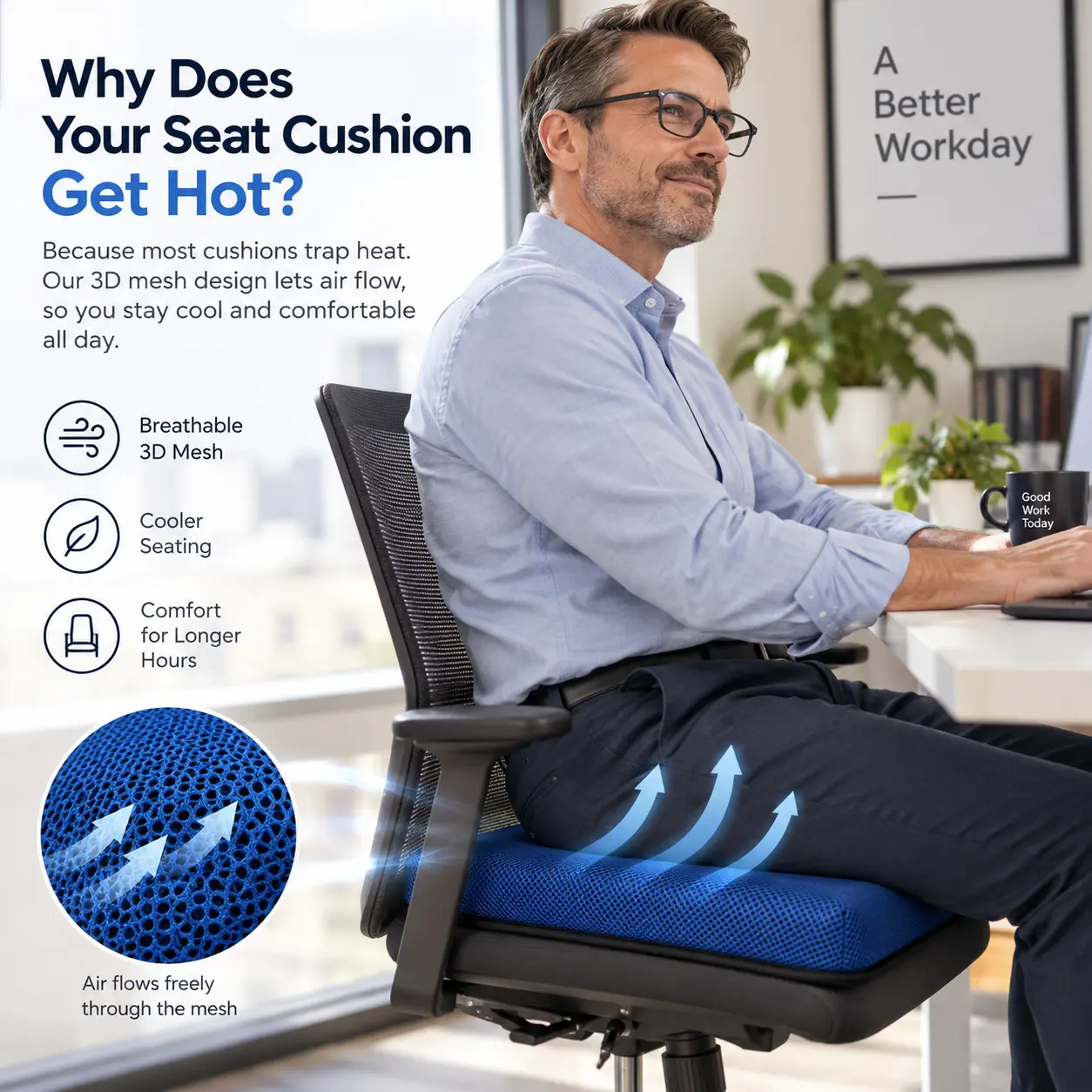
A seat cushion can feel comfortable when you first sit down and surprisingly warm an hour later.
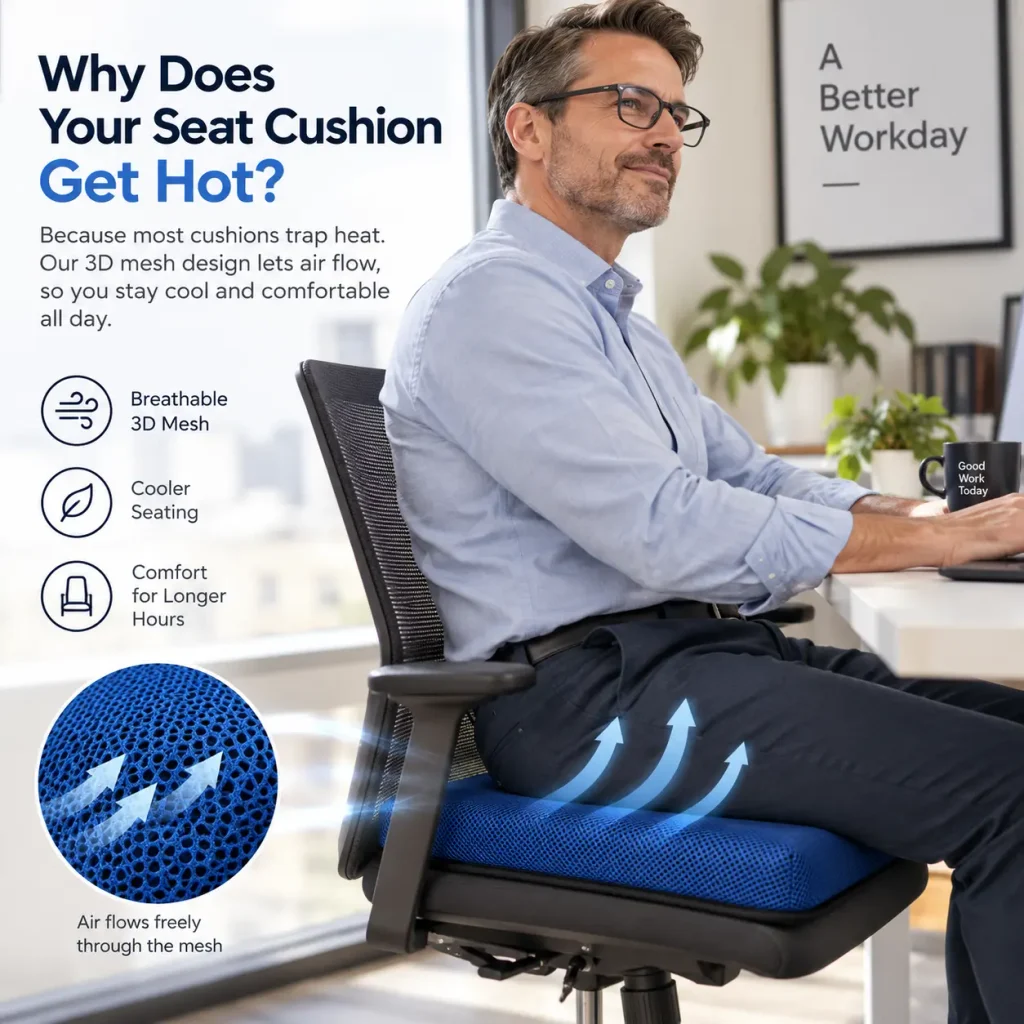
That matters if you work at a desk all day, spend hours behind the wheel, travel frequently, or simply live somewhere with hot summers. A cushion that adds softness but traps heat can solve one comfort problem while creating another.
So what actually makes a breathable seat cushion?
The answer is more complicated than choosing a product labeled “cooling.” Breathability depends on the entire seating system: the cushion core, the cover, the spaces available for air movement, how deeply you sink into the material, and even the chair underneath it.
Understanding those factors makes it easier to choose a cushion for long sitting without relying on marketing claims.
Why Do Seat Cushions Get Hot?
When you sit, your body is in continuous contact with the cushion. That contact limits the natural movement of air between your clothing and the seat.
At the same time, your body continuously produces heat.
If the cushion has a dense surface and limited ventilation, some of that heat remains near the contact area rather than dissipating into the surrounding air. Moisture can also accumulate, making the seat feel warmer or less comfortable over time.
Three factors are especially important:
1. The Cushion Core
Different cushioning materials behave differently under load.
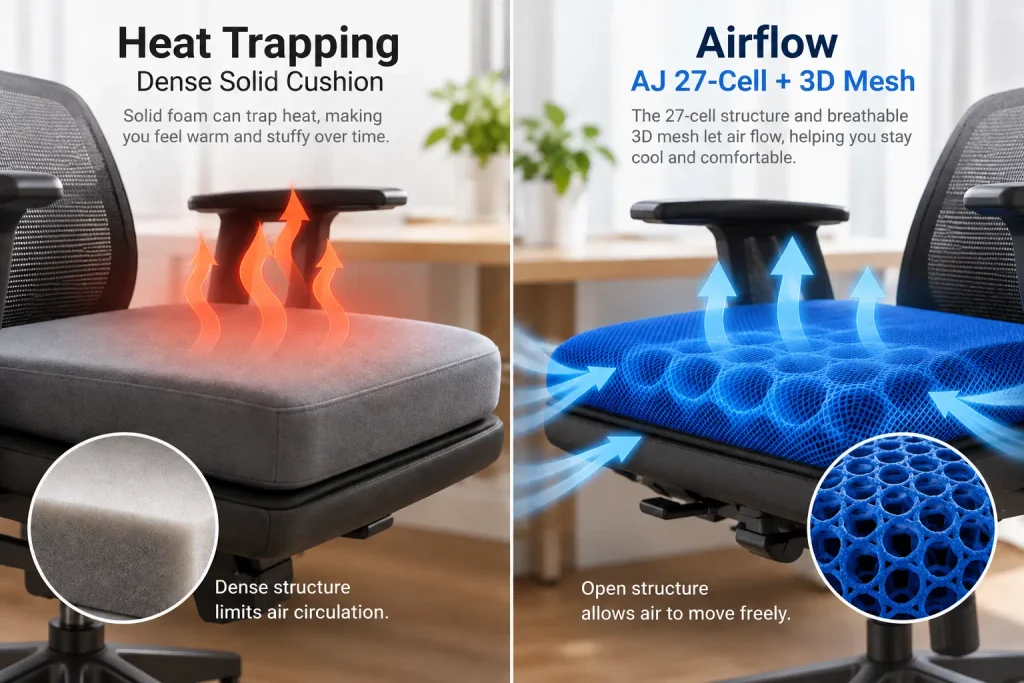
Dense foam conforms around the body as it compresses. That can create a large contact area between the user and the cushion.
Gel layers may feel cool when first touched, but initial surface temperature is not the same thing as continuous ventilation.
Air-based structures work differently because the support medium itself does not need to be a solid block of material. Depending on the design, spaces between individual air chambers can provide additional paths for ventilation.
This does not mean every air cushion will automatically feel cool. The cover and overall construction still matter.
2. The Cover Material
A breathable core can still feel warm if it is wrapped in a dense, poorly ventilated cover.
When evaluating a cushion, look beyond words such as “premium fabric.” Consider whether the cover has an open structure that allows air and moisture to move.
A 3D mesh cover, for example, uses a three-dimensional textile structure rather than a completely flat layer. The small open spaces within the fabric can help create ventilation pathways between the user and the cushion beneath.
For everyday use, removability is useful too. A washable cover makes it easier to manage perspiration, dust and normal buildup from frequent sitting.
3. How Much You Sink Into the Cushion
Softness and breathability are not necessarily the same thing.
A very soft cushion may allow the body to sink deeply into its surface. As more material wraps around the contact area, airflow can become more restricted.
This is one reason the “softest” cushion is not automatically the most comfortable choice for several hours of sitting.
A better objective is balanced support: enough cushioning to make the seat comfortable without creating excessive sinking.
That is where adjustability can become useful.
Breathability vs. Cooling: They Are Not the Same Thing
“Cooling” is widely used in seating products, but consumers should distinguish between two concepts.
Cooling sensation describes how cool something feels, particularly when you first touch it.
Breathability describes how effectively the construction allows heat and moisture to move away from the contact area over time.
A material can feel cool initially without providing significant ventilation during a three-hour drive or an eight-hour workday.
For long sitting, breathability is usually the more useful characteristic to evaluate.
Instead of asking only, “Does this cushion feel cool when I touch it?” ask:
What happens after I have been sitting on it for two hours?
What Should You Look for in a Breathable Seat Cushion?
If heat buildup is one of your main concerns, evaluate the cushion as a complete system.
Look for a combination of:
- an open or ventilated cover structure;
- internal spaces that do not completely block airflow;
- a firmness level that avoids unnecessary sinking;
- removable, washable materials;
- a design suitable for the chair or vehicle where you actually plan to use it.
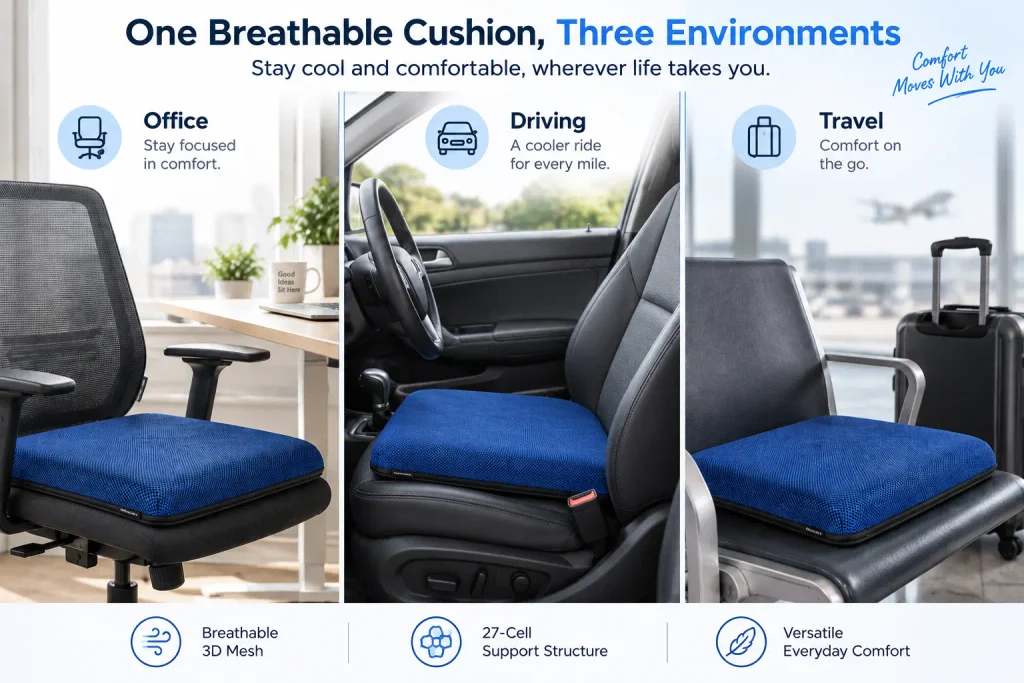
The chair itself matters as well. A cushion placed on an open mesh office chair has a different ventilation environment from the same cushion placed on a solid vinyl vehicle seat.
No cushion can change the surrounding temperature, so expectations should remain realistic. Breathable construction is about managing the seating microenvironment more effectively—not functioning like an air conditioner.
Why Air-Cell Construction Can Help Create Ventilation Space
An air cushion does not need to rely on one continuous block of foam.
In a multi-cell design, separate air chambers can create channels and spaces across the cushion structure. When paired with an appropriate cover, those spaces can contribute to a more ventilated seating surface.
The current AJ AIR CUSHION 3D Mesh Air Seat Cushion uses 27 interconnected air cells beneath a breathable 3D mesh cover.
The interconnected system also allows internal air to redistribute as the user’s position changes. Its built-in press-to-inflate system lets the user adjust the amount of air rather than accepting one factory-set firmness.
This matters for breathability because firmness affects how deeply the body settles into the cushion.
More inflation is not automatically better. Neither is less.
The objective is to find a comfortable inflation level that provides support without creating unnecessary pressure or excessive sinking.
Office Chairs: Think Beyond the Chair Back
Breathability gets plenty of attention when people buy an office chair. Mesh chair backs are common precisely because airflow matters during long work sessions.
The seat surface deserves the same consideration.
If you spend much of the workday seated, a breathable office chair cushion should complement the chair rather than simply adding another thick layer of material.
Pay attention to:
- cushion thickness after you sit down;
- whether your feet remain comfortably positioned;
- whether the cushion changes your relationship to the desk or armrests;
- whether the cover remains comfortable after several hours.
A cushion should be considered part of the workstation, not an isolated accessory.
Driving in Warm Weather
Vehicle seats present another challenge.
Cars can become hot quickly, and many vehicle seats use upholstery that offers less ventilation than an open office chair.
A car seat cushion for summer therefore needs to do more than feel soft.
A breathable surface, ventilation spaces and adjustable firmness can all be useful characteristics for commuting and longer drives.
But a cushion should never interfere with safe driving. Make sure it sits securely, does not slide during normal vehicle operation, and does not place you in an awkward driving position.
AJ AIR CUSHION uses a non-slip base designed to help the cushion remain stable on common seating surfaces.
Travel: Breathability Matters When You Cannot Change the Seat
Travel creates a different problem: you usually cannot choose the chair.
Airport seating, airplanes, trains and rental vehicles all have different surfaces and firmness levels.
A lightweight adjustable cushion gives travelers one seating variable they can control.
For frequent travelers, consider whether a cushion is:
- light enough to carry;
- easy to reposition;
- adjustable without a separate pump;
- washable after repeated use;
- suitable for multiple types of seats.
The AJ design integrates its inflation mechanism into the cushion, so an external hand pump is not required for normal adjustment.
Is a Breathable Cushion Worth It for Long Sitting?
If you regularly notice heat or moisture buildup while sitting, breathability deserves to be treated as a primary buying criterion rather than an extra feature.
But it should not be evaluated alone.
A practical long-sitting cushion needs to balance airflow, support, stability, adjustability and portability.
The best choice is not necessarily the cushion with the thickest foam, the coolest first touch or the largest number of ventilation holes.
It is the design that works with your seat, your environment and the way you actually sit.
For people who move between an office chair, vehicle and travel seating, adjustable air support combined with breathable mesh offers one approach to achieving that balance.
FAQ
What is the most breathable material for a seat cushion?
There is no single material that guarantees the best result. Breathability depends on both the cover and internal construction. Open 3D mesh fabrics can provide ventilation pathways, while internal gaps or channels can help prevent the cushion from behaving like a completely solid surface.
Are air cushions cooler than memory foam?
They use fundamentally different structures, but perceived temperature depends on the complete product. An air-cell cushion with ventilation spaces and breathable mesh may allow more airflow than a dense solid cushion, but room temperature, clothing, chair material and individual use also affect comfort.
Does a cooling gel cushion stay cool all day?
A cool initial touch should not be confused with continuous cooling. Once the material absorbs heat from the user and surrounding environment, its temperature can change. Evaluate long-term ventilation rather than relying only on the first-touch sensation.
Is a breathable seat cushion useful for driving?
It can be particularly relevant in warm vehicle interiors and on long drives. Choose a cushion that combines ventilation with a stable, non-slip design and make sure it does not interfere with your normal driving position.
How firm should an air seat cushion be?
There is no universal inflation level for everyone. Start with moderate inflation and adjust gradually until you find balanced support without excessive hardness or sinking. This is one advantage of an adjustable air cushion.
CTA
Make Your Seat Adapt to You
Long hours do not always happen in the same chair. AJ AIR CUSHION combines a breathable 3D mesh cover, 27 interconnected air cells and built-in air adjustment so you can fine-tune your seat for work, driving or travel.