
When people shop for a seat cushion, one of the first questions is usually about material: foam, gel, or air?
But there is another question that can matter just as much:
How firm should a seat cushion actually be?
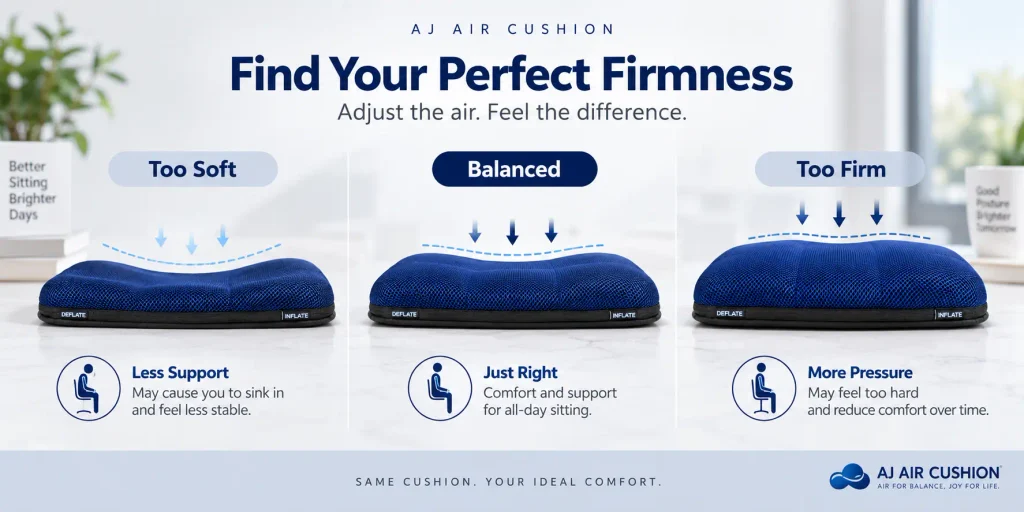
The answer is not simply “soft” or “firm.” A cushion should provide enough support to keep you from sinking excessively while still allowing your body to settle comfortably into the surface.
That balance can change depending on your body, your chair, how long you sit, and even what you are doing while seated.
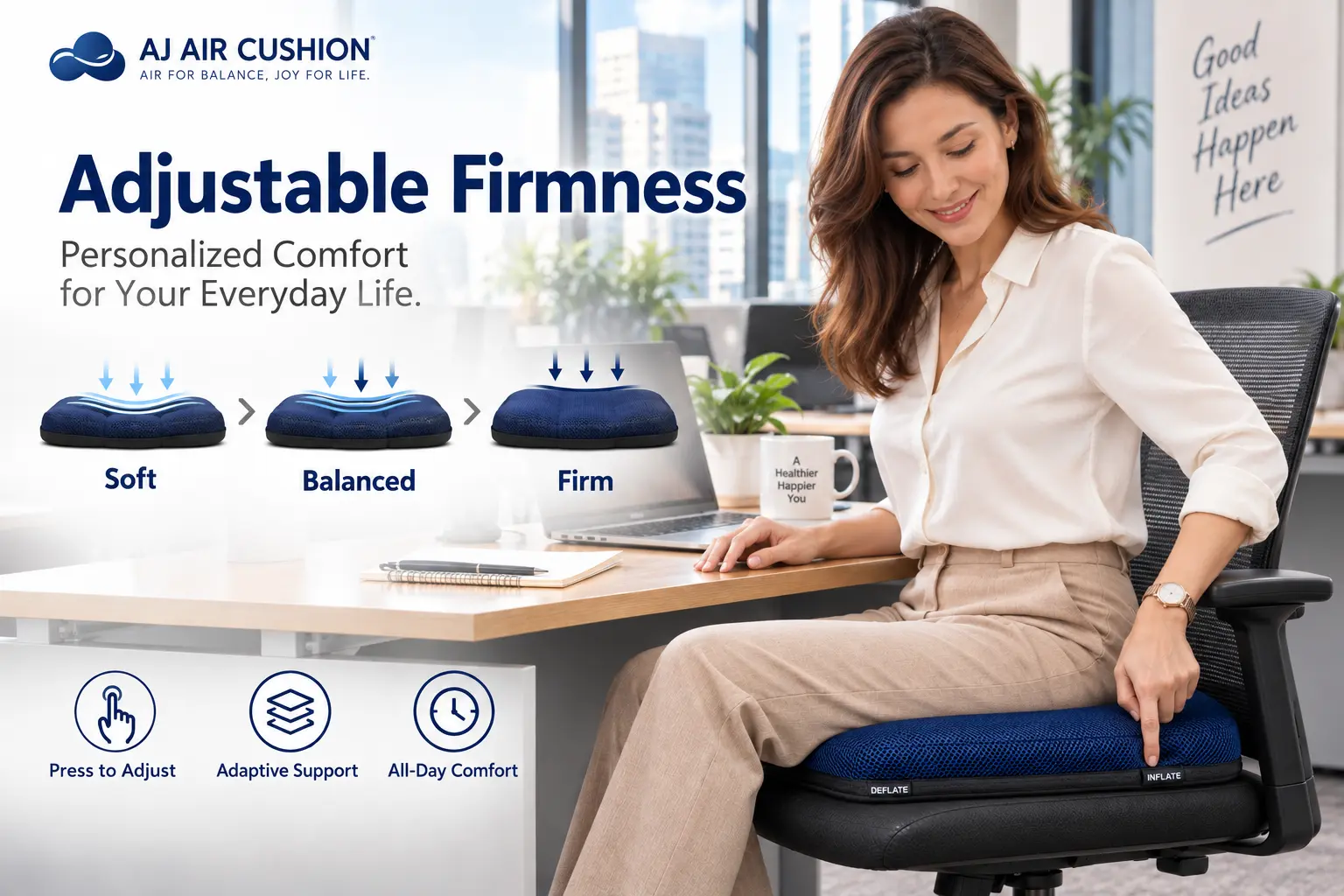
This is also one reason adjustable air cushions are different from fixed-density foam. Instead of accepting one factory-set firmness, you can change the amount of air until the cushion feels appropriate for your seating situation.
Why Softer Does Not Automatically Mean More Comfortable
A very soft cushion can feel pleasant during the first few minutes. That initial sensation, however, does not necessarily tell you how the cushion will feel after an hour or an entire work session.
When a cushion allows excessive sinking, you may lose some of the support you expected from the added padding. On the other hand, an extremely firm cushion may feel stable but provide too little give for comfortable weight distribution.
Research examining seating surfaces has found that cushion design and sitting posture can affect interface-pressure patterns, while subjective comfort is also related to pressure characteristics. That does not mean one cushion firmness is universally best; it reinforces the importance of matching the seating surface to the individual and situation.
The practical goal is therefore not to find the softest cushion.
It is to find a comfortable level of support without excessive sinking or excessive firmness.
What Determines the Right Seat Cushion Firmness?
Several variables affect how a cushion feels.
Your Body Weight and Sitting Position
Two people can sit on the same cushion and experience it very differently.
Body weight changes how much a cushion compresses, while posture changes where your weight is concentrated. Leaning forward at a computer, sitting upright while driving, and relaxing against a seatback do not load a cushion in exactly the same way.
This is why a single fixed firmness cannot perfectly match every person and every sitting position.
The Chair Underneath the Cushion
Your cushion does not work independently of your chair.
A hard wooden dining chair creates a very different foundation from a padded office chair or vehicle seat. If the underlying seat is already soft, adding an extremely soft cushion may create more sinking than you want.
On a firmer chair, slightly more cushioning may feel appropriate.
Always evaluate the chair and cushion as one seating system, rather than judging the cushion by itself.
How Long You Sit
A cushion that feels comfortable for a 20-minute breakfast may not feel the same during a four-hour work session or a long drive.
Long sitting also involves repeated posture changes. You lean forward, shift sideways, reach for something, recline, and return upright.
That makes adjustability particularly useful for people who use one cushion in several environments.
How Adjustable Air Changes the Equation
Traditional foam is manufactured at a predetermined density and firmness. If you’re comparing different cushioning materials, see our air cushion vs. memory foam guide for a closer look at how adjustable air differs from fixed foam.
An adjustable air cushion works differently.
By increasing or decreasing its internal air volume, you can change how the cushion responds when you sit on it.
AJ AIR CUSHION uses 27 interconnected air cells. As body position changes, air can redistribute through the interconnected structure rather than relying on one solid block of cushioning material.
The cushion also incorporates a built-in press-to-inflate system, allowing firmness adjustment without carrying a separate pump.
This does not mean “more air equals more support.”
In fact, overinflating an air cushion can make it feel unnecessarily rigid. The objective is to use enough air to provide comfortable support while retaining some ability for the body to settle into the air-cell surface.
A Simple Way to Adjust an Air Seat Cushion
There is no universal number of pumps that works for everyone, so use feel and sitting position rather than chasing an exact inflation count.
Step 1: Start Conservatively
Begin with a moderate amount of air rather than inflating the cushion as firmly as possible.
Place it on the chair you actually intend to use.
Step 2: Sit Normally
Do not judge firmness by pressing the cushion with your hand.
Sit on it.
Your full body weight interacts with the air cells differently from hand pressure.
Remain in your normal working, driving, gaming, or home sitting position for several minutes.
Step 3: Notice Excessive Sinking or Excessive Firmness
If you feel as though you are sinking too deeply toward the chair underneath, add a small amount of air.
If the cushion feels overly rigid or creates a “perched” sensation, release a small amount.
Make gradual adjustments rather than large ones.
Step 4: Recheck After Longer Sitting
Your first impression is useful, but it should not be your only test.
Use the cushion through a normal sitting session and reassess. Your preferred setting may change once you have spent more time on it.

Should You Use the Same Firmness for Office, Driving, and Travel?
Not necessarily.
One of the advantages of an adjustable cushion is that the setting does not have to remain identical everywhere.
For an office chair, you may prefer a balanced setting that allows comfortable movement as you alternate between typing, meetings, and leaning back.
In a vehicle, seat contour, driving posture, and available headroom can change how much inflation feels comfortable.
For travel, portability and the existing seat shape also matter. An airplane seat, waiting-area chair, and hotel desk chair all provide different foundations.
Instead of searching for one permanent “perfect” setting, think of firmness as something you can fine-tune for the environment.
Firmness Is Only One Part of Long-Sitting Comfort
Even a well-adjusted cushion does not replace good sitting habits.
During long periods of sitting, periodically change position and take appropriate movement breaks when possible. Make sure your feet are supported and your workstation or driving position is reasonably arranged.
Also consider heat and moisture.
A cushion’s surface construction matters alongside its internal support. AJ AIR CUSHION combines its adjustable air-cell structure with a removable 3D mesh cover designed to promote airflow around the seating surface.
No cushion can make prolonged sitting risk-free, and a consumer seat cushion should not be treated as medical treatment.
Its role is much more practical: to make the surface you sit on more adaptable and comfortable for everyday use.
The Bottom Line
So, how firm should a seat cushion be?
Firm enough to support you without excessive sinking, but not so inflated or rigid that the surface feels hard and unyielding.
There is no single firmness level that is right for every person, chair, or situation.
That is precisely where adjustable air support becomes useful.
Rather than buying a cushion and adapting yourself to its fixed firmness, you can fine-tune the cushion to the way you actually sit.
For office work, driving, travel, gaming, or everyday home seating, small adjustments can help you find your preferred balance between cushioning and support.
Looking for adjustable support for your everyday seating? Explore AJ AIR CUSHION seat cushions for office work, driving, travel, and everyday sitting.
Air for Balance, Joy for Life.
FAQ
Is a firm or soft seat cushion better for long sitting?
Neither is automatically better. Excessive softness can allow too much sinking, while excessive firmness may feel uncomfortable. Look for a balance between support and cushioning that works with your body and chair.
Can an air seat cushion be overinflated?
Yes. More air is not necessarily better. If an air cushion feels unusually rigid or you feel perched on top of it rather than comfortably supported, try releasing a small amount of air and reassessing.
How often should I adjust an air cushion?
There is no required schedule. Recheck the setting whenever you move the cushion to a different type of chair or when the current firmness no longer feels appropriate.
Should my seat cushion feel the same in my car and office chair?
Not necessarily. Vehicle seats and office chairs have different contours, padding, angles, and sitting positions. An adjustable cushion lets you fine-tune firmness for each environment.
Does a seat cushion replace movement breaks?
No. A cushion is an everyday comfort aid, not a substitute for changing position, moving periodically, or obtaining professional advice when persistent discomfort requires evaluation.
Ready to Find Your Preferred Level of Air Support?
Explore AJ AIR CUSHION seat cushions designed for adjustable everyday comfort at the office, on the road, while traveling, and at home.