
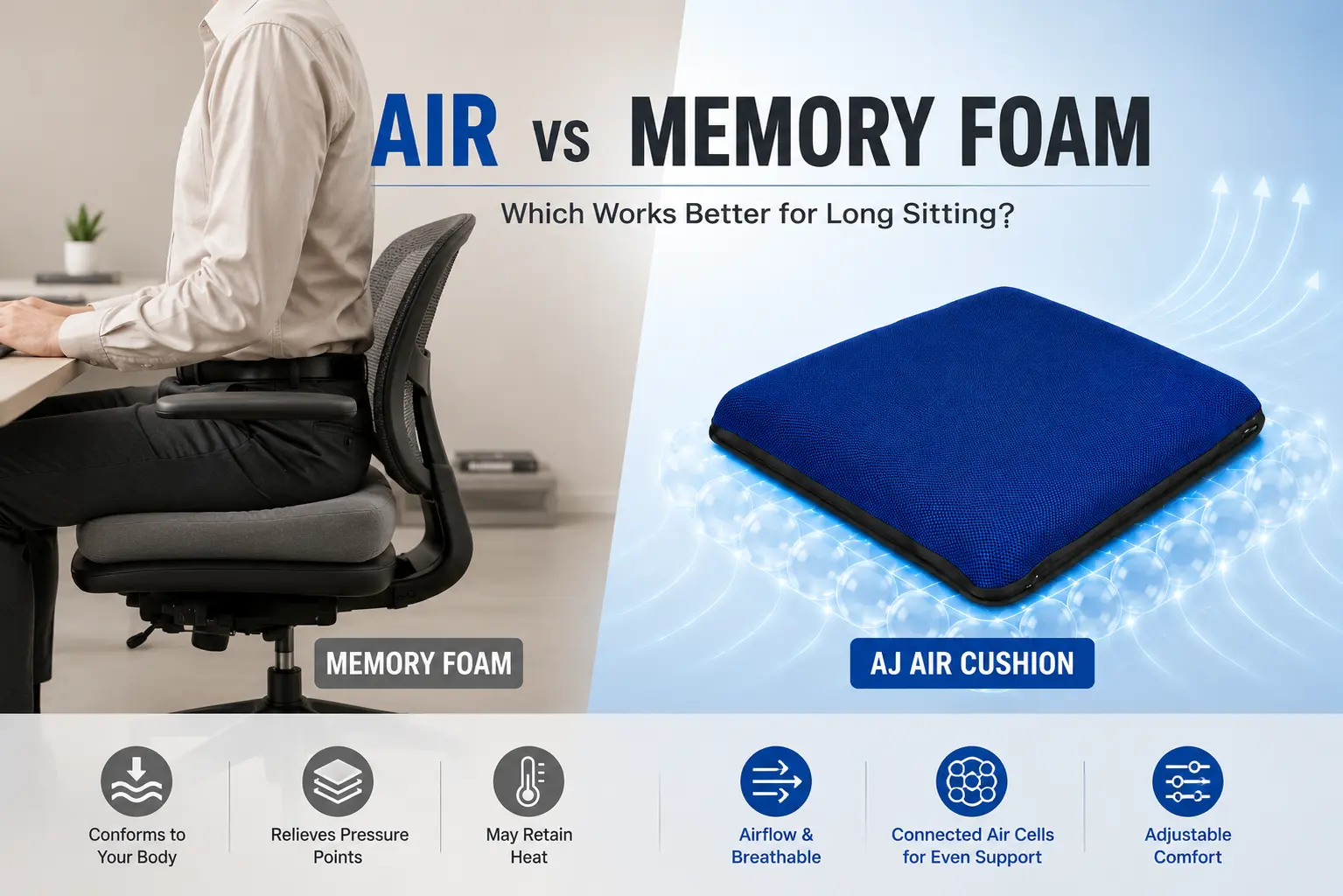
If you sit for long hours at a desk, behind the wheel, or while traveling, choosing the right seat cushion can make a noticeable difference in everyday comfort.
Two of the most common options are air seat cushions and memory foam cushions.
Both can add cushioning, but they work in very different ways.
Memory foam relies on a fixed foam structure that compresses under body weight. Air cushions use enclosed air chambers that can respond to pressure and, in some designs, allow users to adjust firmness.
So which is better for long sitting?
The answer depends on what matters most to you: adjustability, airflow, portability, stability, and how you prefer your seat to feel.
Related Guide: Best Seat Cushion Features for Office Work, Driving and Travel
How Memory Foam Cushions Work
Memory foam responds to heat and pressure by slowly conforming to the shape of the body.
This creates a soft, molded sitting feel that many users find comfortable at first.
Memory foam may be a good choice if you prefer:
- a soft, fixed-density surface
- a cushion that contours around the body
- little or no adjustment during use
However, the firmness is largely determined by the foam itself. Once you choose a specific density and thickness, there is limited ability to change how the cushion feels.
How Air Seat Cushions Work
Air cushions replace a solid foam core with air-filled chambers.
The AJ Air Cushion flagship design uses 27 connected air cells, allowing air to move across the cushion as sitting pressure changes.
The internal air level can also be adjusted using a built-in press pump.
Instead of relying on one fixed material density, the user can fine-tune the air volume to make the cushion feel softer or firmer. For people who use the same cushion in different environments, that flexibility can be valuable.
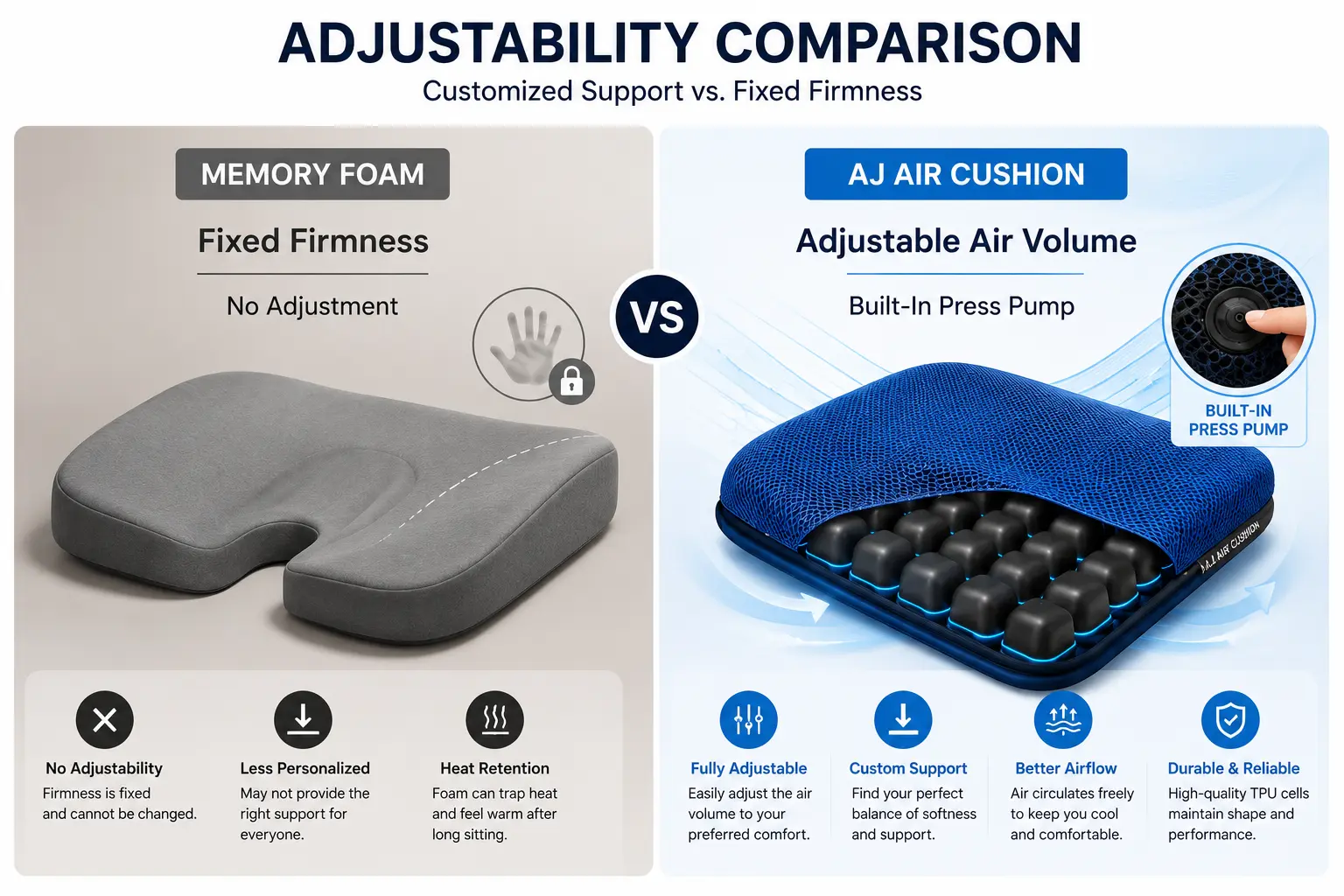
1. Adjustability
This is one of the biggest differences.
A memory foam cushion has a fixed firmness. Its feel may soften somewhat as it warms, but users cannot meaningfully change the density.
An adjustable air cushion gives the user more control. With AJ Air Cushion, the built-in press pump allows air volume to be changed without carrying a separate pump.
This can be useful when moving between:
- office chairs
- car seats
- home seating
- travel seats
If personalization is a priority, air cushions have a clear advantage.
2. Breathability
Long sitting often creates heat around the seating surface. Dense foam can retain warmth, especially in warmer rooms or vehicles.
Breathability therefore depends heavily on the cushion cover and construction.
AJ Air Cushion uses a 3D mesh cover designed to encourage airflow around the seating surface. Air-filled internal chambers also reduce the amount of dense material directly beneath the user.
For people who tend to feel warm during extended sitting, breathable construction is an important factor to compare.
3. Pressure Distribution
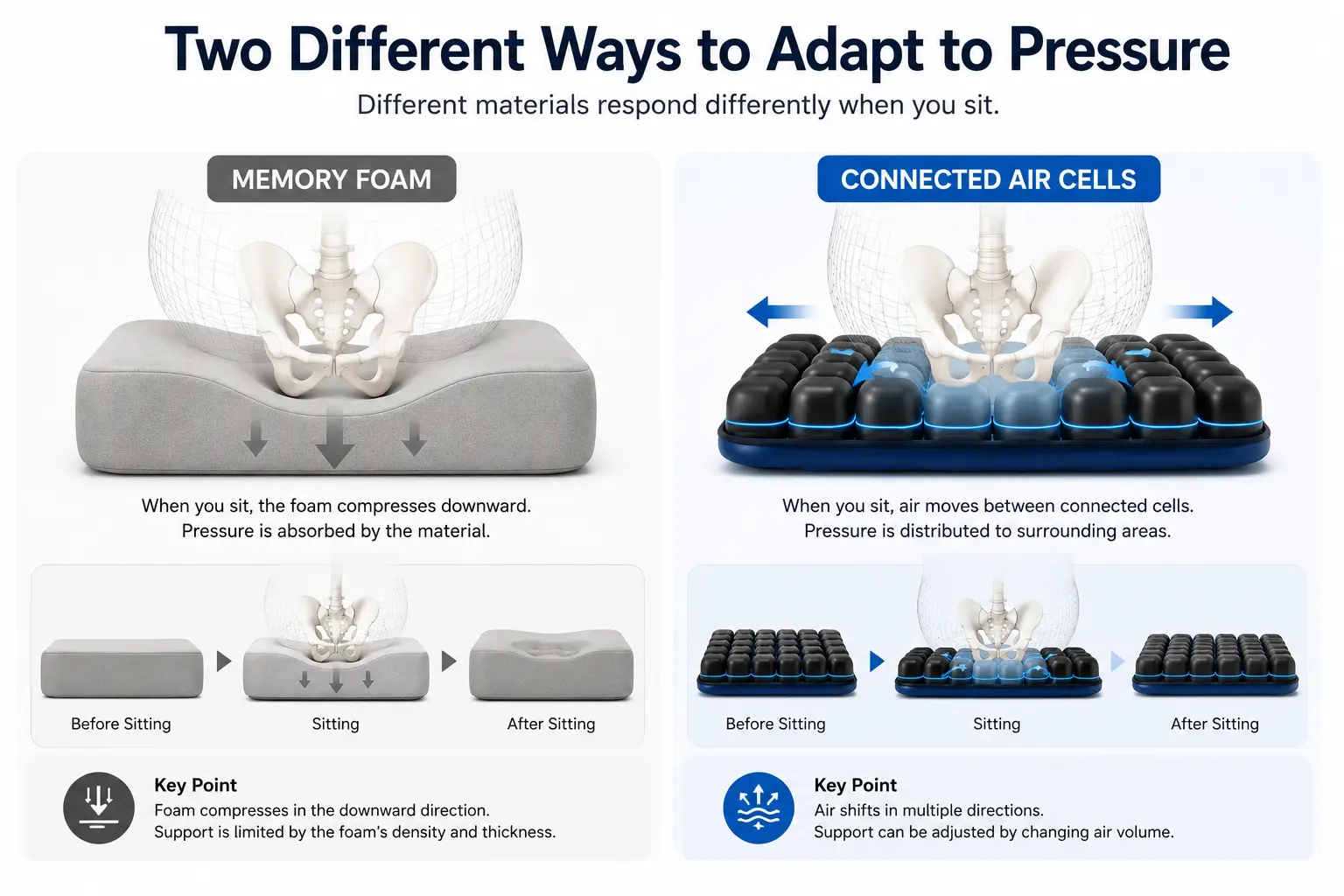
Memory foam distributes pressure by compressing and conforming to the body. Air cushions use changes in air pressure instead.
In an interconnected air-cell system, air can move between different sections as the user shifts position. This helps create a more responsive sitting surface rather than one fixed compressed shape.
Neither approach should be described as universally superior for every person. The practical difference is that memory foam adapts through material compression, while air cushions adapt through air movement and adjustable volume.
4. Portability
Memory foam cushions can be relatively bulky because their thickness comes from solid material. Air cushions can be lighter because much of their internal volume is air.
This makes air-based designs particularly attractive for people who regularly carry a cushion between home, work, vehicles, and travel locations.
For frequent travelers or commuters, portability can become just as important as cushioning.
5. Long-Term Feel
Memory foam gradually compresses under repeated use. The rate depends on foam density, body weight, temperature, and product quality.
Air cushions do not rely on a solid foam core for their primary support. Instead, firmness can be adjusted by changing the amount of air inside the cushion.
This means users can make small changes over time rather than being limited to the original factory-set firmness.
Air Cushion vs Memory Foam: Quick Comparison
| Feature | Air Seat Cushion | Memory Foam |
|---|---|---|
| Adjustable firmness | Yes | No |
| Personalized support | High | Medium |
| Breathability | High with mesh construction | Varies |
| Portability | High | Medium |
| Fixed molded feel | No | Yes |
| Easy firmness changes | Yes | No |
| Lightweight design | Often | Varies |
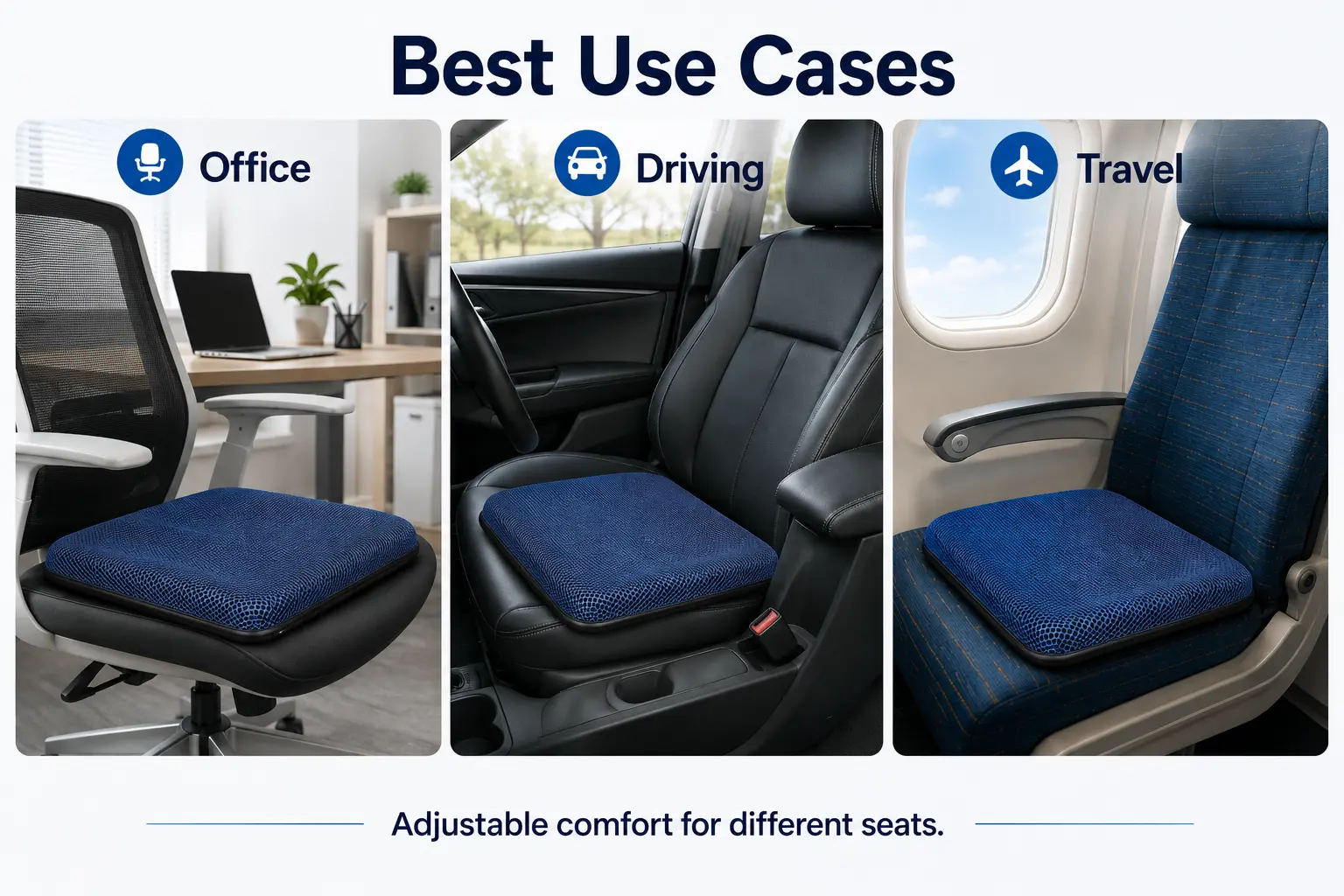
Which Is Better for Office Work?
For office work, both options can work.
Memory foam may suit someone who wants a simple, soft cushion and does not need to adjust it. An air cushion may be more practical if you want to change firmness during the day or use the same cushion across several chairs.
For long desk sessions, breathability and stable positioning should also be considered.
Which Is Better for Driving?
Driving requires more caution because any cushion changes your seating height and position.
A cushion should not interfere with:
- pedal reach
- steering control
- visibility
- seat-belt positioning
An adjustable air cushion can be useful because the user can reduce air volume if the cushion feels too high. Moderate thickness and a non-slip base are especially important for vehicle use.
Which Is Better for Travel?
For travel, air cushions generally have an advantage in portability and adjustability.
A single cushion may need to work on an airport chair, airplane seat, rental vehicle, and hotel chair. Being able to change firmness for different surfaces can make an air cushion more versatile.
Why AJ Air Cushion Uses Air Instead of Foam
AJ Air Cushion was developed around an adjustable air-cell approach rather than a fixed foam core.
27 Connected Air Cells
Designed to respond as sitting pressure changes.
Built-In Press Pump
Allows firmness adjustment without an external pump.
Breathable 3D Mesh
Designed to encourage airflow during extended sitting.
High-Grip Bottom
Helps keep the cushion stable during everyday use.
The result is a lightweight cushion designed for office work, driving, travel, and home seating.
Frequently Asked Questions
Is an air cushion better than memory foam?
Not for everyone. Air cushions are better suited to users who value adjustability and portability, while memory foam may appeal to people who prefer a fixed soft feel.
Do air cushions feel firm?
They can feel soft or firm depending on air volume. Moderate inflation is usually a better starting point than maximum inflation.
Does memory foam get hot?
Some memory foam cushions can retain heat, although cover material and ventilation design make a significant difference.
Can I use an air cushion every day?
Yes, provided the cushion fits your chair properly and is used in a way that maintains a safe and comfortable sitting position.
Which One Should You Choose?
Choose memory foam if you prefer a simple, fixed, molded sitting feel.
Choose an air seat cushion if you want greater control over firmness, easier portability, and the ability to adapt one cushion to different seating environments.
For people who move between an office chair, car seat, and travel seating, adjustability can be one of the most practical advantages.