
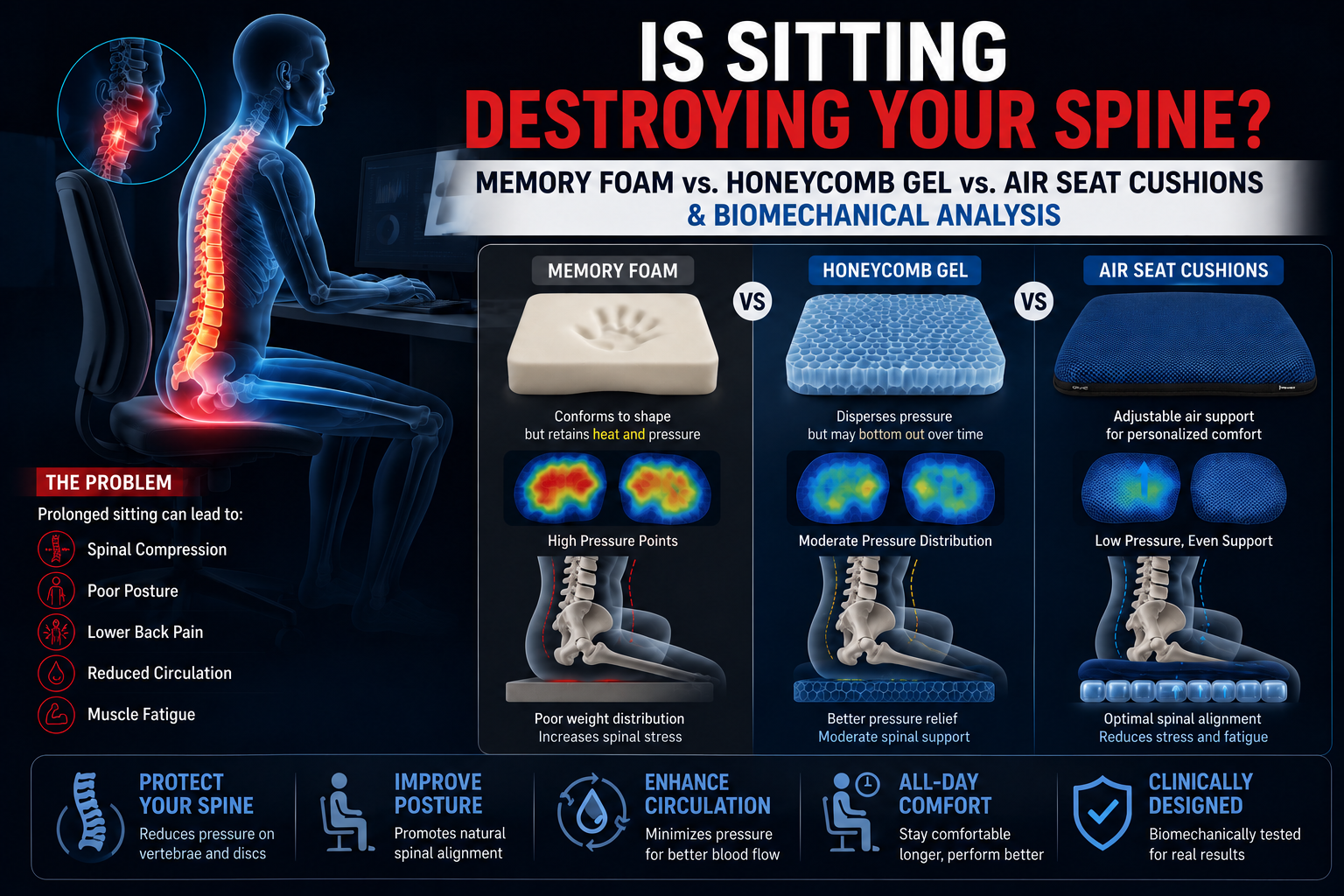
In modern society, prolonged sitting has become an unavoidable part of everyday life. Office professionals, software engineers, long-haul truck drivers, frequent travelers and wheelchair users often spend many hours seated each day.
However, most people overlook a critical reality: the cushion you sit on can influence pelvic alignment, pressure distribution, heat buildup and long-term sitting comfort. While memory foam pads and honeycomb gel cushions often claim to offer pressure relief, their real-world performance can vary greatly during long sitting sessions.
This article uses international sitting-health research and biomechanical engineering principles to compare memory foam, honeycomb gel and connected air seat cushions, then explains why adjustable air support can be a smarter option for reducing concentrated sitting pressure.
Health note: This article is for general ergonomic education only and is not medical advice. If you have persistent back pain, numbness, circulation issues or a diagnosed spinal condition, consult a qualified healthcare professional.
1. Medical Research Warning: Prolonged Sitting Is a Real Health Concern
The phrase “sitting is the new smoking” is often simplified, but the underlying concern is real: high amounts of sedentary time are associated with higher health risks, especially when not balanced with regular physical activity.
Large-scale research published in The Lancet found that higher levels of moderate-intensity physical activity can help offset the increased mortality risk associated with long daily sitting time. A JAMA Cardiology study also reported that high amounts of sitting time were associated with increased risk of all-cause mortality and cardiovascular disease events.
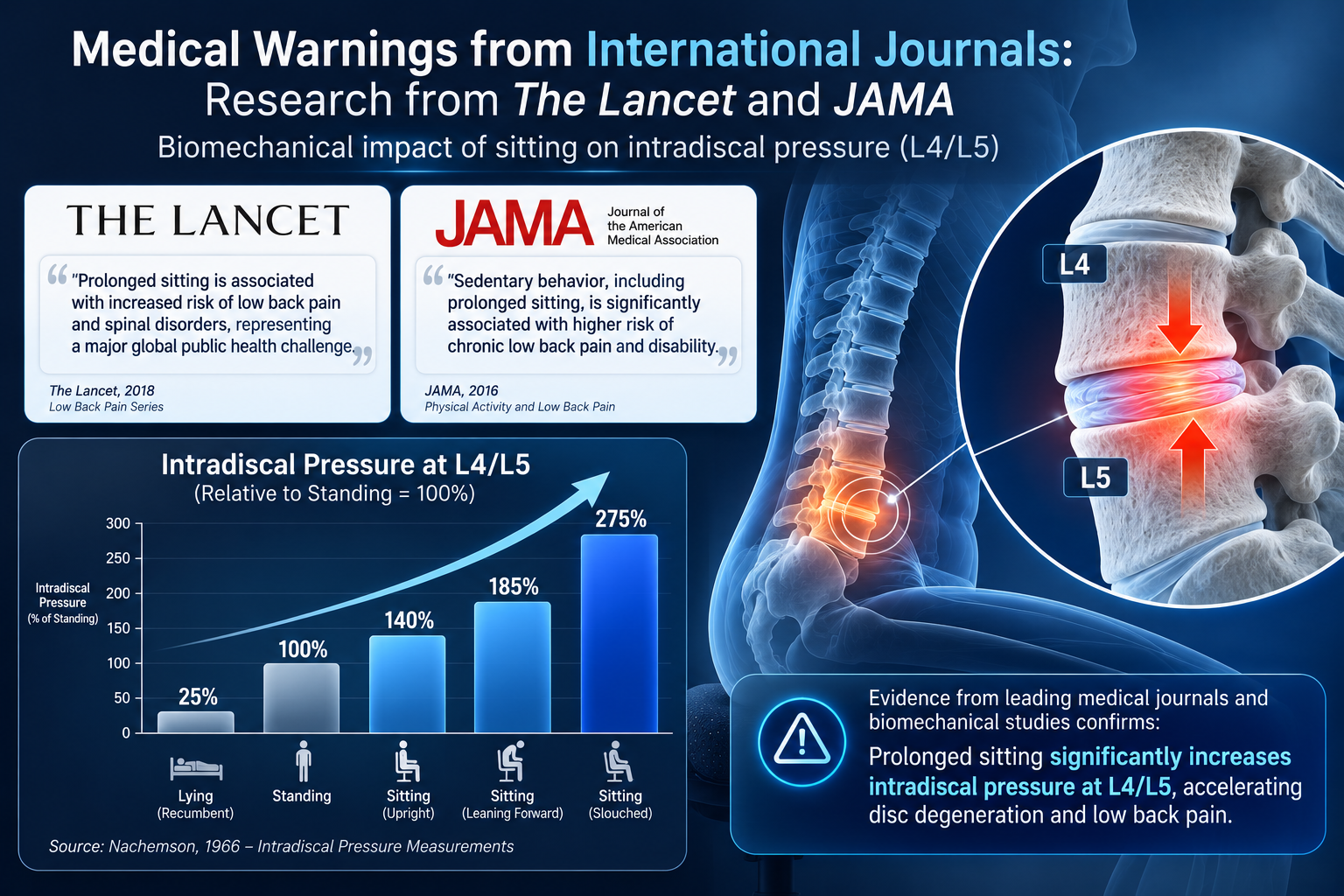
Biomechanical Insight: Intradiscal Pressure Escalation
Many people assume sitting is a resting position. Biomechanically, however, sitting can place greater physical load on the lumbar spine than standing, particularly when the pelvis rolls backward and the lower back loses its natural curve.
Relative Lumbar Discal Pressure Across Positions

Standing Neutral               100% baseline
Erect Sitting                  about 140%
Slouched / Forward Sitting     about 180% to 275%
Bottomed-Out Cushion Collapse  about 220% to 300%
When seated, the legs absorb less body weight and force becomes concentrated around the pelvis and ischial tuberosities. If a cushion collapses or fails to distribute pressure, the pelvis may tilt backward, flattening the lumbar curve and increasing compression through the lower spine.
2. Memory Foam vs. Honeycomb Gel vs. Connected Air Cushions
Traditional Memory Foam Cushions
Mechanism: Memory foam uses heat-sensitive polyurethane foam to mold around the body.
Main limitation: Memory foam can feel soft at first, but after absorbing body heat and weight, the foam may compress and lose lift. This “bottoming-out” effect can leave the tailbone and pelvic pressure points closer to the hard chair base. Dense foam also tends to trap heat.
Honeycomb Gel Cushions
Mechanism: Honeycomb gel cushions usually use TPE or silicone grids that flex under body weight and create airflow channels.
Main limitation: Gel cushions can be heavy and less convenient for travel. Under higher or uneven load, grid walls may buckle sideways, creating inconsistent support and pressure variation.
Connected Air Cushions
Mechanism: Connected air cushions use a matrix of multi-layered air cells. When seated, air moves through internal pathways and seeks pressure balance across the cushion surface.
Advantage: Based on fluid pressure distribution principles, interconnected air cells can spread sitting load more evenly and reduce peak pressure around the pelvic bones.
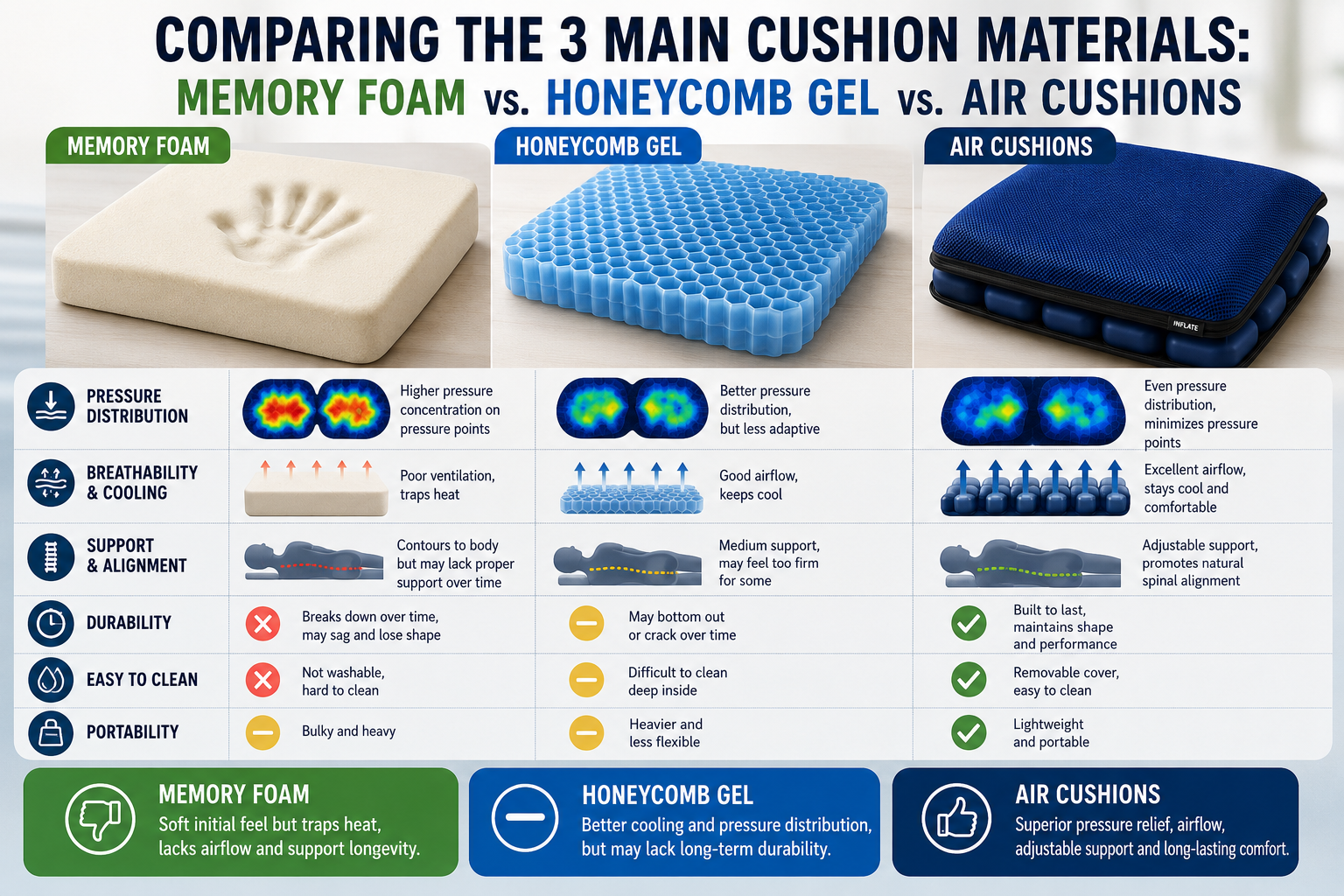
3. Comprehensive Performance Comparison
| Ergonomic Indicator | Memory Foam Cushion | Honeycomb Gel Cushion | Patented Air Cushion |
|---|---|---|---|
| Pressure Relief Principle | Passive deformation | Passive grid buckling | Active fluid pressure balance |
| Peak Pressure Elimination | Poor: may collapse into hard base | Moderate: uneven grid collapse may occur | Exceptional: distributes peak pressure across connected cells |
| Breathability & Heat Control | Poor: dense insulation traps heat | Moderate: channels exist, but material can hold heat | Exceptional: inter-cell channels plus breathable 3D mesh |
| Structural Durability | Poor: prone to permanent sagging | Moderate: grid walls may lose elasticity | High: heavy-duty air cells designed for repeated sitting use |
| Firmness Adjustability | Non-adjustable | Non-adjustable | Tool-free push-pump adjustability |
| Portability | Moderate: bulky | Poor: often heavy | Superior: adjustable, portable and travel-friendly |
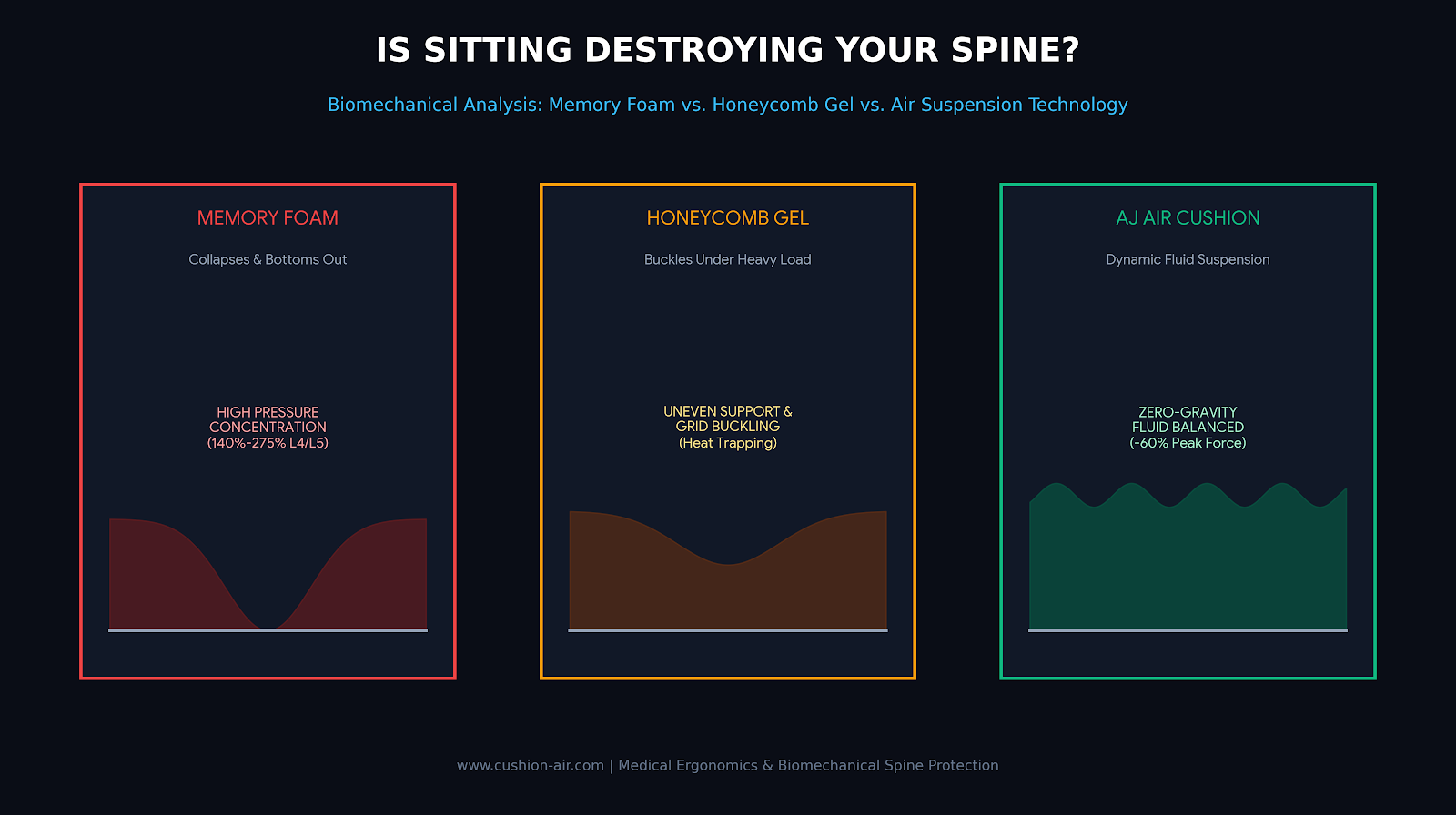
4. How Ergonomic Air Cushions Actively Relieve Sitting Pressure
Eliminating Peak Pressure
When seated, a large share of upper-body weight lands on two small pelvic contact points. Connected air cells redirect air outward toward the thighs and hips, converting localized point pressure into broader surface support.
Supporting Pelvic Alignment
Stable air support beneath the hips can help reduce backward pelvic tilting. Better pelvic position supports a more natural spinal curve and may improve comfort around the lower back during long sitting sessions.
Encouraging Sitting Comfort and Micro-Movement
By reducing high-pressure hot spots, air support can make it easier to sit comfortably for longer periods. The adjustable air structure also encourages small posture changes, which are important for comfort during desk work, driving and travel.
Tool-Free Push-Pump Inflation
An integrated manual push-pump allows users to fine-tune cushion firmness without mouth inflation or external tools. This makes adjustment easier at a desk, in a vehicle or during travel.
5. Conclusion: A Smarter Investment for Long Sitting
Prolonged sitting may be an unavoidable part of modern work and mobility, but how you sit is still within your control. Memory foam and gel cushions can be useful in some situations, but they may flatten, trap heat or provide inconsistent support over time.
For users who need breathable, adjustable and pressure-balanced support, an interconnected air cushion such as the AJ 3D Mesh Air Seat Cushion offers a more dynamic seating platform for office work, driving, travel and everyday mobility.
References and Further Reading
- The Lancet: Physical activity and sitting time in relation to mortality
- JAMA Cardiology: Sitting time, mortality and cardiovascular events
- Lumbar spine intradiscal pressure research review
SEO Hashtags: #AirSeatCushion #AJAirCushion #BackPainRelief #SciaticaRelief #ErgonomicSeatPad #SittingDisease