
In the modern world, we are sitting ourselves into a health crisis. From the morning commute to the eight-hour office grind and the evening couch unwind, our bodies are trapped in a static “C-shape” posture that our ancestors never faced. This sedentary lifestyle is not merely about muscle stiffness; it is a full-body structural collapse that affects everything from your spinal integrity to your cellular metabolism.

The Biomechanical Chain Reaction of Inactivity
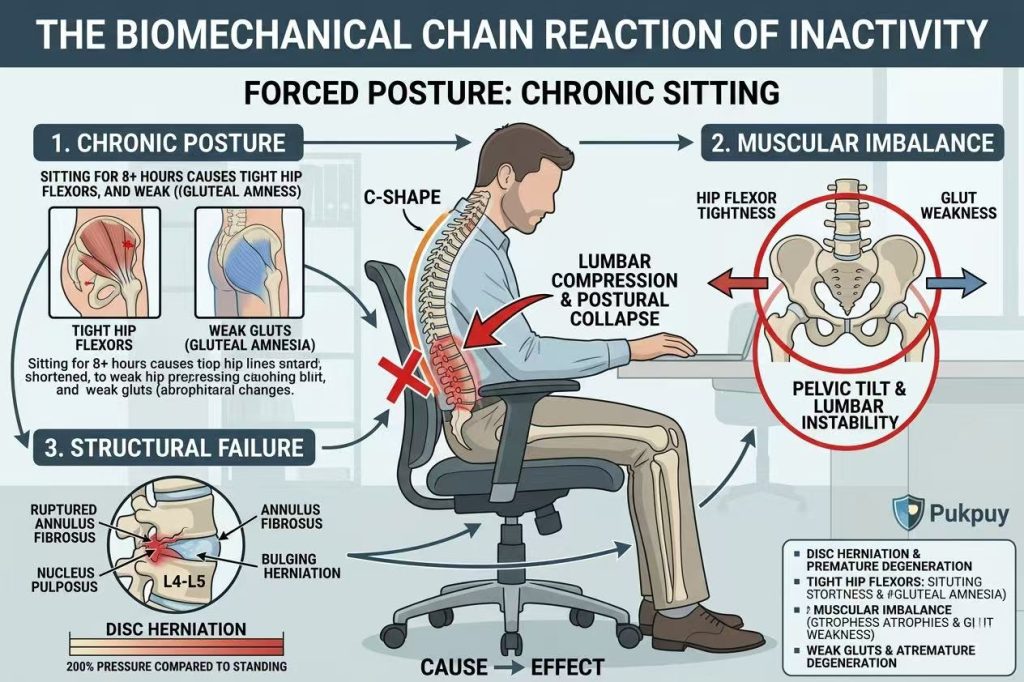
When you sit for extended periods, a destructive mechanical cycle begins within your musculoskeletal system:
- Gluteal Amnesia and Hip Imbalance: Prolonged sitting keeps your hip flexors in a chronically shortened, tight state. This forced position causes your gluteal muscles—the primary stabilizers of your lower back—to become inactive or “weak,” a phenomenon known as gluteal instability.
- The Pelvic Tilt: As hip flexors tighten and glutes weaken, the pelvis is pulled into an unnatural tilt. This creates lumbar instability, forcing the lower spine to bear weight it wasn’t designed to handle, resulting in chronic lower back pain.
- Spinal Pressure Multipliers: Slouching in an office chair or on a sofa doesn’t just feel bad—it increases the physical pressure on your spinal discs by 200% compared to standing. This relentless compression is a leading cause of premature disc herniation and permanent spinal degeneration.
The Silent Epidemic: Metabolic and Circulatory Impact
The damage extends far beneath the skin and bone. Your internal systems require movement to function at peak efficiency:
- Metabolic Shutdown: Within just hours of sitting, the enzymes responsible for burning fat and processing blood sugar drop by as much as 90-95%. By the eight-hour mark, your fat-burning efficiency can plummet by 50%, drastically increasing the risk of Type 2 diabetes and obesity.
- Circulatory Stagnation: A sedentary body is a stagnant body. Slowed blood flow increases the risk of Deep Vein Thrombosis (DVT) and clots, while also putting a higher strain on the cardiovascular system, significantly elevating heart disease risks.

Strategic Defense: Reclaiming Your Vitality
To counter this “Silent Epidemic,” you must adopt a proactive defense strategy:
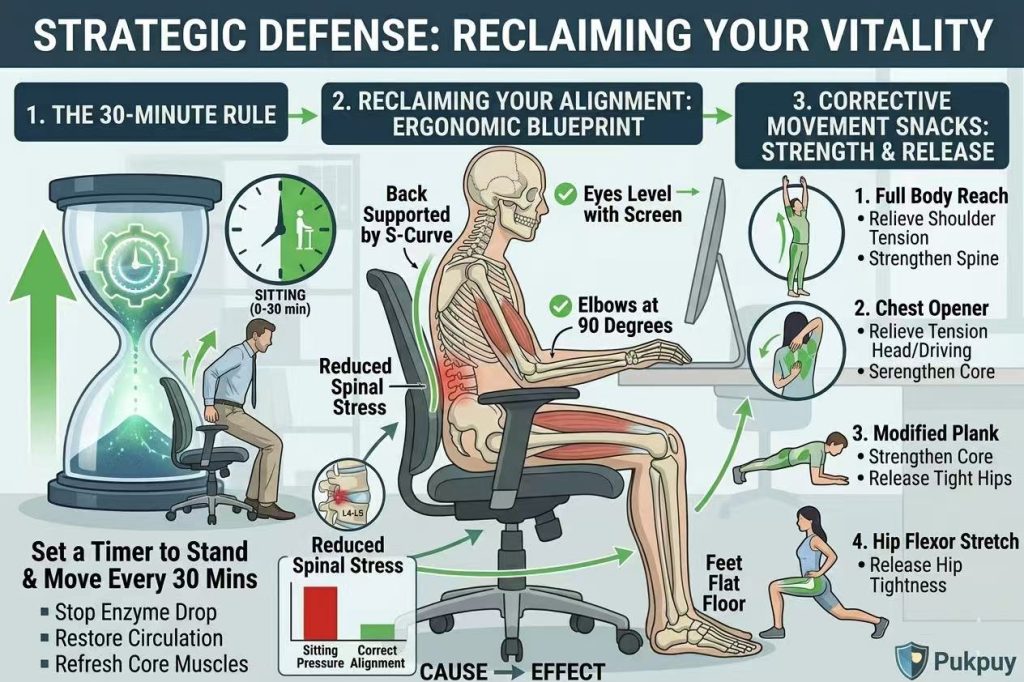
- Ergonomic Alignment: Ensure your monitor is at eye level and your chair provides a natural S-curve lumbar support.
- The 30-Minute Rule: Your body has a “sitting limit.” Set a timer to stand, stretch, and move every 30 minutes to restart your metabolic enzymes.
- Corrective Movement: Use “Micro-Break Stretches” like the Full Body Reach to lengthen the spine and the Chest Opener to relieve shoulder tension accumulated during driving or typing.
Supporting Evidence & Visual Guides
[Visual 1: The Bio-Mechanical Chain Reaction]
This graphic illustrates how tight hip flexors lead to gluteal amnesia and subsequent chronic lower back instability.
[Visual 2: Metabolic Rate vs. Sitting Hours]
A data-driven chart showing the steep decline in fat-burning enzymes after just 1 to 8 hours of inactivity.
[Visual 3: Spinal Degeneration Infographic]
A detailed look at how disc herniation and muscle atrophy are accelerated by a sedentary daily routine.